
Conditions – Priority
Back Pain Treatment in Baltimore
If you have done physical therapy for back pain before and it didn't hold, the problem wasn't you. It was the approach. Cookie-cutter PT treats the symptom. I treat the mechanism driving it.
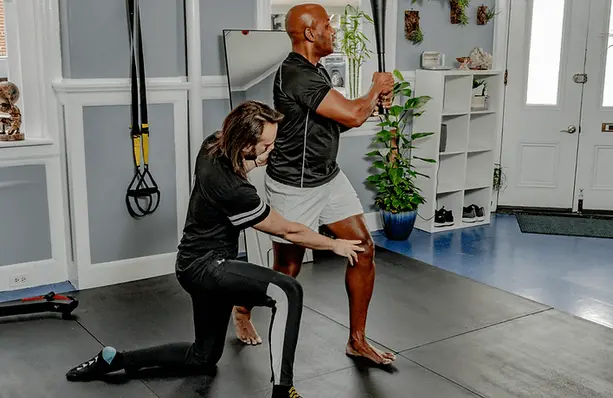
The Difference
Why Most Back Pain Treatments Fail. And What's Different Here
Most back pain treatment follows the pain. Heat, stretching, a sheet of core exercises, maybe a massage where it hurts. The pain fades for a week and returns, because the thing that loaded the tissue in the first place was never touched.
My approach starts one level up: what is loading your back? At the first visit I assess your fascial system, your neural mobility, and your posture as one picture, then treat the drivers, not just the site. One-on-one, every session, so nothing gets lost between providers.
The Mechanism
What's Actually Causing Your Back Pain
Four upstream drivers account for most persistent back pain. You should understand why your back hurts, not just that it does.
Fascial Restriction
The connective tissue sheath around your spinal muscles adheres and shortens, limiting spinal mobility and forcing painful compensation.
Neural Tension
An irritated nerve loses its glide and refers pain along its path, often felt as sciatica, numbness, or tingling far from the source.
Postural Loading
Thoracic kyphosis or anterior pelvic tilt concentrates load on a few lumbar segments, hour after hour, until tissue fails.
Diaphragmatic Dysfunction
A diaphragm that doesn't descend fully can't pressurize the trunk. Your spine loses its deepest stabilizer and small muscles overwork.
The Treatment
How Dr. Birikov Treats Back Pain at Physica Medica
Treatment begins with a comprehensive assessment of the fascial, neural, and postural systems. From there, I build a stack of techniques matched to your findings and deliver all of them myself, in the same session.
Manual Therapy, Dry Needling & Cupping for Back Pain
Manual therapy restores joint mobility segment by segment. Dry needling releases trigger points in the paraspinal musculature, quadratus lumborum, and piriformis at their neuromuscular source. Myofascial cupping decompresses fascial adhesions that pressure alone cannot reach. Neural tension release restores nerve glide for radicular symptoms. Posture re-education, including Pancafit work available nowhere else in the country, removes the loading pattern so the pain does not come back.
Because sessions are not shaped by insurance-dictated limits, the full stack fits in one visit. That is the practical advantage of the concierge model: undivided time, applied where your body needs it.
Will It Hurt? Will It Work?
What to Expect: Your First Visit for Back Pain
01
Assessment
We identify the mechanism driving your pain through movement testing and a detailed history.
02
Treatment
Hands-on manual therapy and targeted interventions applied directly to the tissues driving symptoms.
03
Plan
You leave with a clear plan, specific exercises, and an understanding of what's actually happening.
I evaluate your movement, identify the dysfunction pattern, and explain what I find before treatment begins. You will know what I am doing and why at every step. Some techniques involve brief discomfort; a dry needling twitch response lasts a second, and cupping marks fade within days. Nothing is done to you without explanation.
The first session includes both assessment and treatment. One-on-one, no aides, no handoffs, no exercise sheet handed to you while the therapist walks away. You leave knowing what is causing your pain, what the plan is, and roughly how many sessions it should take.
From Google Reviews
Outcomes, In Patients' Words
[Real patient testimonial will be placed here — back pain outcome after prior PT failed]
[Real patient testimonial will be placed here — chronic lower back pain outcome]
[Real patient testimonial will be placed here — sciatica or radicular pain outcome]
Baltimore
Back Pain Treatment in Baltimore, Serving Fells Point, Canton and Beyond
The clinic is at 800 S Bond St in Fells Point, a short drive or walk from Canton, Harbor East, Patterson Park, and Federal Hill. Most back pain patients come from these waterfront neighborhoods; many walk in from desk jobs in Harbor East and leave with a plan the same day.
Common Questions
Back Pain Treatment, Answered Directly
{{ faq.a }}