
Neck Pain
Neck Pain Treatment in Baltimore
If your neck pain keeps returning despite stretching, massage, or a previous round of physical therapy, the problem is almost certainly upstream from where it hurts. Tight muscles are a symptom. The mechanism driving them is not.
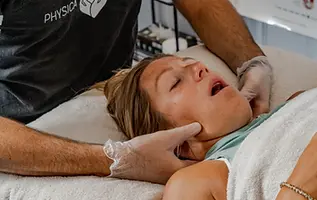
Why It Keeps Coming Back
Neck Pain That Won't Go Away — Why It Keeps Coming Back
Most neck pain treatment targets the cervical spine in isolation. Mobilize the joint, stretch the muscle, apply heat, send the patient home with a band and a handout. It works for a few weeks, sometimes longer. Then the pain returns, because nothing changed the pattern that caused it.
Persistent neck pain is rarely a neck problem. It is a postural loading problem that expresses itself in the neck. The cervical spine sits at the top of a chain. When the thoracic spine rounds forward and the head drifts in front of the shoulders, the posterior cervical muscles work continuously just to hold the head up. At a forward head posture of two to three inches, the effective load on those muscles can more than double. That load does not rest. It accumulates.
The Mechanism
The Connection Between Neck Pain, Posture & Fascial Tension
Three structural drivers account for most chronic cervical pain. Understanding them is the starting point for actually fixing it.
Forward Head Posture
Forward head posture shifts the center of mass of the skull anterior to the cervical spine. The suboccipital muscles, upper trapezius, and levator scapulae contract chronically to compensate. Over time, they develop trigger points — dense, hyperirritable bands of muscle tissue that refer pain into the base of the skull, across the shoulders, and down into the upper back. This is the mechanism behind most tension headaches originating from the neck.
Thoracic Kyphosis
Thoracic kyphosis — the rounding of the mid-back common in desk workers and screen-heavy professionals — forces the cervical spine into compensatory extension. The joints at the base of the neck take disproportionate load. The fascia surrounding the posterior cervical muscles shortens and adheres. Mobility decreases. Pain becomes the signal that the system is overloaded.
Fascial Restriction
The cervical fascia is a continuous connective tissue network that surrounds and connects every muscle, nerve, and joint in the neck. When it tightens — through chronic posture, old injury, or scar tissue — it restricts movement and amplifies pain signals. Stretching and joint mobilization alone do not address fascial adhesions. The tissue itself has to be mechanically mobilized.
Diaphragmatic Dysfunction
A diaphragm that doesn't descend fully can't pressurize the trunk. Your spine loses its deepest stabilizer and small muscles overwork.
The Treatment
How Physica Medica Treats Neck Pain in Baltimore
Treatment at Physica Medica begins with a full postural and movement assessment — not a symptom checklist. I identify where in the chain the dysfunction originates: thoracic mobility, scapular positioning, breathing mechanics, fascial tension patterns. Then treatment addresses those drivers directly, not just the cervical segment that is producing pain.
Dry Needling, IASTM & Manual Therapy for Neck Pain
Dry needling targets active trigger points in the upper trapezius, suboccipital group, levator scapulae, and scalenes. A thin monofilament needle is inserted directly into the trigger point, producing a local twitch response that releases the contracted tissue and restores normal muscle tone. This is not acupuncture. There is no meridian theory involved. The mechanism is neuromuscular: the needle elicits a reflex that the muscle cannot override voluntarily.
IASTM — instrument-assisted soft tissue mobilization — follows. Specifically contoured stainless steel instruments are applied to the posterior cervical fascia, the upper thoracic region, and the pectoral fascia to break down adhesions and restore tissue extensibility. The combination of dry needling and IASTM addresses both the neuromuscular and connective tissue components of cervical pain in the same session. Most local clinics offer one or the other. Both, sequenced correctly, produce a different depth of result.
What to Expect
Neck Pain Treatment Results — What to Expect
01
Assessment
The first visit includes a detailed postural analysis and movement screen. I identify the dysfunction pattern driving your pain, explain what I find, and begin treatment in the same session.
02
Treatment
Hands-on intervention begins immediately. Dry needling, IASTM, and manual therapy are applied based on what the assessment reveals — not a standardized protocol. Sessions run 60 minutes, one provider, one patient.
03
Plan
You leave with a specific exercise plan, postural cues relevant to your work setup, and a clear picture of how many sessions are likely needed. No vague timelines.
Most patients with mechanical neck pain begin to notice meaningful change within two to four sessions. Chronic presentations — long-standing stiffness, recurring headaches, post-surgical cervical cases — typically require a longer course. I will give you an honest estimate at the first visit based on what I find, not a number designed to fill a schedule.
Dry needling to the cervical region produces a brief, deep ache at the moment of the twitch response. It is not comfortable, but it is brief and well-tolerated by most patients. IASTM may produce mild redness or temporary soreness in the treated area. Neither should significantly worsen your condition. If you have widespread pain sensitivity or a history of fibromyalgia, I adjust technique and dosage accordingly.
Almost nothing is worse than when your body is in pain. Max expertly treated my symptoms, accurately determined the cause, and, perhaps most importantly, educated and empowered me through the entire process. He is ridiculously knowledgable and even more compassionate.
Outcomes, In Patients' Words
Baltimore
Serving Neck Pain Patients in Fells Point, Canton & Harbor East
Physica Medica is located at 800 S Bond St in Fells Point, within easy reach of Canton, Harbor East, and the surrounding neighborhoods. A significant portion of patients here are professionals spending eight or more hours a day at a desk or screen — the exact population in which forward head posture and thoracic rounding develop and compound over years. If that describes your situation, the neck pain you are experiencing is not incidental to how you work. It is a direct consequence of it, and it responds well to treatment that accounts for that.
Common Questions
Neck Pain Treatment, Answered Directly
{{ faq.q }}
{{ faq.a }}