
Rehabilitation Strength Training
Strength Training That Starts with Why You're Weak, Not Just How to Get Stronger
Weakness is rarely the starting point. It is usually the result — of a compensation pattern, a postural imbalance, a movement fault that has been loading the wrong structures for months or years. Before I program a single exercise, I identify what created the deficit. Then we build strength from there.
The Distinction
Rehabilitation Strength vs. General Fitness — What's the Difference?
A gym program assumes your movement patterns are sound and your joints are loaded correctly. It adds resistance to whatever mechanics you already have. If those mechanics are faulty — and in patients with recurring injuries or chronic pain, they almost always are — adding load accelerates the problem rather than solving it.
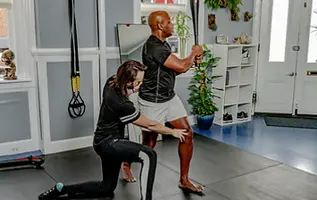
Rehabilitation strength training starts with a clinical assessment. I screen how you move, identify where compensation is occurring, and determine which muscles are inhibited versus which are overworking to compensate. The strength program that follows is built around correcting that pattern, not around a generic progression model.
The difference is not intensity. It is sequencing. Strengthening a hip abductor before addressing the lumbar rotation driving your IT band pain will not fix the IT band pain. Sequence matters. So does knowing which structure to load, at what range, under what conditions.
Who This Is For
Who Benefits from Rehabilitation Strength Training
Athletes who keep getting hurt despite consistent training. The injury changes — hamstring this season, ankle the last, shoulder before that — but the pattern does not. That pattern is a compensation. Strength training that targets the underlying movement fault addresses the actual problem.
People with chronic back pain, neck pain, or sciatica who have been told to 'strengthen their core' without anyone explaining what that means for their specific mechanics. Generic core work does not resolve a pain pattern driven by fascial restriction or postural collapse. Targeted work does.
Post-surgical patients who have completed standard rehabilitation and been cleared for activity, but still feel unstable, asymmetrical, or hesitant under load. Returning to full strength after surgery requires progressive, biomechanically supervised loading — not a return to the gym with fingers crossed.
Clinical Integration
How Strength Training Integrates with Physical Therapy at Physica Medica
Strength training here is not a separate offering bolted onto a PT session. It is one component of a treatment plan that may also include IASTM, dry needling, myofascial cupping, or Pancafit postural correction, depending on what the assessment indicates. The modalities inform each other.
Assessment First
Every strength program begins with a full movement screen and hands-on evaluation. I am not watching for how much you can lift. I am watching for where your body compensates, braces, or collapses under load.
Max is my go to PT for anything -- back pain, HIT workouts, and fitness advice in general. Super-knowledgeable and really gets the inner workings of your muscles -- knows how to create the type of workout that avoids injury and undue muscle/ligaments stress.Conditions
Common Conditions Addressed Through Targeted Strength Work
Chronic Back Pain
Persistent back pain is frequently sustained by strength imbalances between the anterior and posterior chain. Identifying which segments are underloaded and which are compensating changes the treatment entirely.
Recurring Sports Injuries
IT band syndrome, hamstring strains, rotator cuff irritation, and ankle instability that keep returning despite rest and treatment. The recurrence is the signal — the underlying movement fault has not been addressed.
Sciatica and Nerve Pain
Numbness and tingling driven by neural tension or lumbar compression often have a strength component. Stabilizing the structures around the nerve changes the mechanical environment it lives in.
Post-Surgical Recovery
Scar tissue, inhibited musculature, and altered movement patterns after surgery require a careful, progressive return to loading. Cleared for activity does not mean ready for a standard gym program.
Hunched back, forward head posture, and rounded shoulders are not just flexibility problems. The muscles that should hold the spine upright are weak and inhibited. Postural correction requires strengthening, not just stretching.
Before You Book
Begin Your Assessment
Can strength training help with chronic back pain?
Yes — but only if the strength work targets the actual source of the problem. Chronic back pain is frequently maintained by an imbalance between the muscles that should stabilize the lumbar spine and the ones that are overworking to compensate. Generic core exercises address none of that specificity. A clinical assessment identifies which muscles are inhibited, which movement patterns are loading the wrong structures, and what the correct sequencing of strength work looks like for your spine. That is a different intervention than what most people have tried.