
Dry Needling — Baltimore, MD
Dry Needling with Dr. Birikov, DPT
Intramuscular stimulation of trigger points, performed by a Doctor of Physical Therapy in a one-on-one setting. Not delegated. Not rushed. Every needle placement is based on a hands-on assessment I conduct myself — in the same session.
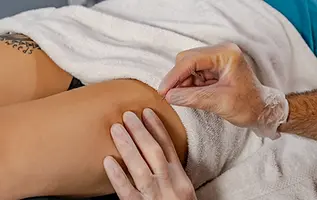
The Definition
What Is Dry Needling — And How Is It Different From Acupuncture?
Dry needling and acupuncture use the same tool — a thin filiform needle — but they operate on entirely different frameworks. Acupuncture is rooted in traditional Chinese medicine and targets energy meridians mapped across the body's surface. Dry needling is grounded in Western musculoskeletal anatomy. The needle goes into a specific muscle at a specific depth to reach a trigger point: a contracted, hypersensitive band of tissue that is generating pain, restricting movement, or referring symptoms elsewhere.
When the needle contacts an active trigger point, the muscle responds with a brief involuntary twitch. That twitch is the mechanism — it disrupts the sustained contraction, increases local circulation, and resets the neuromuscular signaling that was maintaining the dysfunction. The effect is measurable in tissue. It is not acupressure, and it is not a relaxation technique.
I use dry needling as a precision tool, not a trend. It is one component of a treatment plan — not a standalone procedure performed by someone who met you ten minutes ago. The clinical value depends entirely on accurate trigger point identification, which requires hands-on assessment before a needle is placed.
Clinical Applications
Conditions Dry Needling Treats at Physica Medica
Dry needling is most effective for conditions driven by myofascial dysfunction — pain and restriction that originate in the muscle and connective tissue rather than in structural damage alone.
Back pain and sciatica: Trigger points in the lumbar paraspinals, gluteus medius, and piriformis are common drivers of both local back pain and radiating leg symptoms. Needling these sites reduces the muscular component of nerve compression and referred pain patterns. Neck pain, tension headaches, and migraines: The upper trapezius, levator scapulae, and suboccipital muscles are frequent sources of cervicogenic headache and forward head posture pain. Direct needling of these trigger points can interrupt the referral pattern that feeds into the skull. Rotator cuff and shoulder pain: Infraspinatus and subscapularis trigger points refer pain into the shoulder and down the arm in patterns that are frequently misread as rotator cuff tears. Needling clarifies the diagnosis and addresses the muscular source. IT band syndrome and hip pain: The tensor fasciae latae and vastus lateralis respond well to intramuscular stimulation when foam rolling and stretching have plateaued. Chronic pain after failed treatment: If prior physical therapy did not resolve your symptoms, the trigger points driving them may not have been identified or addressed. That is where reassessment from the mechanism up changes the outcome.
Root cause is the operating principle: effective treatment requires understanding why your body is in pain, not just where. Manual therapy addresses tissue restrictions. Movement analysis finds the compensation patterns. Postural correction addresses the structural drivers that keep re-creating the problem. Separate those, and you get temporary relief. Integrate them, and you get lasting results.
The Session
What to Expect During a Dry Needling Session With Dr. Birikov
The first thing that happens is an assessment. I palpate the tissue, identify active trigger points, and confirm that dry needling is appropriate for what I am finding. No needle is placed without that step.
Back Pain
Once a trigger point is located, a thin sterile needle is inserted directly into the muscle. You will likely feel a dull ache or a brief muscle twitch — that twitch response is the target. Some patients describe it as a deep pressure sensation; others feel a momentary cramping that resolves within seconds. It is not painless, but it is brief and purposeful.
After leaving Dr. Maks table I felt so inspired by his knowledge. I had chronic pain in my right glute and leg muscles and did not know how to escape it. I was in pain most days, but especially sitting in class all day or driving long distances.Back Pain
Once a trigger point is located, a thin sterile needle is inserted directly into the muscle. You will likely feel a dull ache or a brief muscle twitch — that twitch response is the target. Some patients describe it as a deep pressure sensation; others feel a momentary cramping that resolves within seconds. It is not painless, but it is brief and purposeful.
I have had a low back/piriformis/hip flexor problem for years. As a yoga, Pilates, and barre instructor, managing that has been tough. When the pain became unignorable, I turned to dry needling. It has been the only method that truly helped me.Back Pain
Once a trigger point is located, a thin sterile needle is inserted directly into the muscle. You will likely feel a dull ache or a brief muscle twitch — that twitch response is the target. Some patients describe it as a deep pressure sensation; others feel a momentary cramping that resolves within seconds. It is not painless, but it is brief and purposeful.
Max, a PT at Physica Medica is the most incredible therapist. I have suffered from chronic back pain for almost a decade, have been to literally a dozen doctors and last March had back surgery all to no avail. Max has been the only person to take my pain away.Before You Book
Is Dry Needling Right for You? Contraindications and Candidacy
Comprehensive Assessment
Dry needling is not appropriate for everyone. Absolute contraindications include needle phobia severe enough to prevent safe treatment, active infection or open wounds at the treatment site, and certain bleeding disorders or anticoagulant medications that significantly elevate bleeding risk. Pregnancy is a relative contraindication — specific areas of the body are avoided, and treatment decisions are made conservatively on a case-by-case basis.
Movement Screening
Fibromyalgia and widespread chronic pain require a modified approach. Patients with central sensitization can react strongly to intramuscular stimulation, so needle depth, duration, and session intensity are adjusted accordingly. This is not a reason to avoid dry needling — it is a reason to have it performed by someone who understands the neurophysiology and adjusts the protocol in real time.
Hands-On Evaluation
If you have had prior adverse reactions to dry needling or acupuncture, that history matters. Bring it. The most useful thing you can tell me before a first session is what has been tried, what happened, and what did not work. That information shapes the treatment plan before I place a single needle.
Plan & First Treatment
I explain what I found, give you a session estimate, and treatment begins the same day.
Plan for sixty minutes. Frequency depends on the condition. Most patients start weekly, and we taper as your body holds the changes. You will know within three to five sessions whether the approach is working, and I will tell you honestly if it isn't.
Cost and Coverage
Dry Needling Cost and Insurance Coverage in Baltimore
Physica Medica operates on a cash-pay model. I do not bill insurance. That is a deliberate structural choice, not a limitation — it removes the constraints that insurance reimbursement places on session length, treatment frequency, and what techniques can be used in a given visit.