
Biomechanics-Based Personal Training
Training Designed Around How Your Body Actually Moves
This is not rehabilitation. It is precision training for people who are not injured but want to build capacity without creating dysfunction. One session, one provider, a DPT who understands load transfer, compensation patterns, and fascial mechanics — applied to how you train.
The Definition
What Is Biomechanics-Based Personal Training?
Biomechanics-based personal training is programming built around movement quality rather than output metrics. Weight lifted and reps completed are secondary. What matters is whether your joints are centrated under load, whether force is transferring through the right structures, and whether your breathing mechanics are supporting or undermining the movement pattern.
Most personal training ignores these questions entirely. Most physical therapy addresses them only in the context of injury. This program sits between those two categories — clinical precision applied to fitness, designed and delivered by a Doctor of Physical Therapy.
The underlying premise is straightforward: poor movement patterns accumulate. A squat with a collapsed arch and a forward trunk lean does not cause pain today. Over thousands of repetitions, it loads the wrong tissue, creates asymmetric tension in the fascia, and eventually produces an injury that feels sudden but was years in the making. The goal here is to interrupt that process before it completes.
The Method
How Movement Analysis Changes the Way You Train
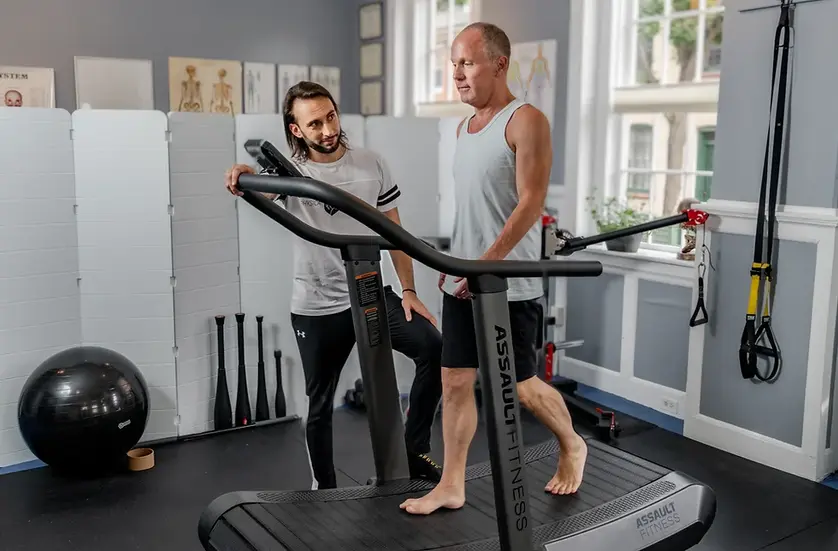
Every program begins with a biomechanical assessment. I watch you move through a structured screen — not a fitness test, a movement diagnostic. I am looking at joint centration at the hip, knee, and shoulder under load; how your thoracic spine rotates relative to your pelvis; where your breathing pattern breaks down when you add resistance; and which muscles are compensating for ones that are not firing efficiently.
That assessment determines your program. Not a template. Not a protocol borrowed from a certification manual. A training structure built around the specific patterns your body is currently running and the specific capacities it needs to develop.
The metrics we track are not the ones on a gym whiteboard. We track whether your load distribution is becoming more symmetric. Whether your breathing mechanics hold under fatigue. Whether the compensation pattern identified in the first session is still present three weeks later. These are the signals that tell us whether training is building capacity or reinforcing dysfunction.
Ideal Candidates
Who This Program Is Designed For
This is not a general fitness program. It is appropriate for a specific type of person.
Athletes managing recurring injuries
If the same structure keeps breaking down — IT band, hamstring, shoulder — the issue is not the tissue. It is the movement pattern loading it. Biomechanics training identifies and corrects the pattern.
I’ve gotten both physical therapy and personal training from Max. In both areas his practice is unique. I have had a lot of injuries from running and tennis, and I believe Max has really helped me down a path to avoid as many injuries as I can down the road.Service Distinction
The Difference Between This and Rehabilitation Strength Training
Rehabilitation Strength Training
Rehabilitation strength training at Physica Medica is designed for people recovering from injury or managing active dysfunction. The goal is correcting deficits — restoring range of motion, rebuilding tissue capacity after surgery, addressing the neurological and fascial changes that follow acute injury. It is clinical work with a functional endpoint.
Biomechanics Personal Training
Biomechanics personal training starts where rehabilitation ends — or never enters that territory at all. The patient is not injured. There is no deficit to correct. The work is about building capacity in a way that is mechanically sound, sustainable over decades, and precise enough to prevent the injuries that poor training habits eventually produce.
Hands-On Evaluation
The tools overlap. The population and the clinical objective do not. If you are currently in pain or recovering from an injury, the rehabilitation strength training program is the appropriate starting point. If you are not injured and want to train with the same clinical rigor applied to a performance and longevity goal, this is the program.
Plan & First Treatment
I explain what I found, give you a session estimate, and treatment begins the same day.
Plan for sixty minutes. Frequency depends on the condition. Most patients start weekly, and we taper as your body holds the changes. You will know within three to five sessions whether the approach is working, and I will tell you honestly if it isn't.
Session Structure
What a Biomechanics Training Session Looks Like
The first session is a full biomechanical assessment. I take a detailed history — not just injury history, but training history, occupation, sleep position, and any symptoms that appear only under load. Then I watch you move. The screen is structured but observational: I am not coaching you yet, I am reading how your system currently operates.