
Scar Tissue Mobilization
Scar Tissue Mobilization in Baltimore
Scar tissue does not have to be permanent. When adhesions restrict joint movement, compress nerves, or create chronic pain after surgery or injury, the tissue can be remodeled. I treat the system the scar has disrupted — not just the scar itself.
The Biology
What Is Scar Tissue and Why Does It Restrict Movement?
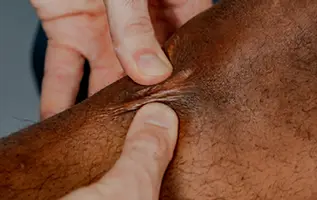
When tissue is damaged — through surgery, trauma, or repetitive strain — the body repairs it with collagen. That repair is fast and functional, but it is not precise. Normal tissue has collagen fibers that run in organized, parallel arrays. Scar tissue lays down collagen in a dense, disorganized mesh. That mesh is structurally inferior and mechanically different from the tissue it replaced.
The problem is not the scar itself. The problem is adhesion. As scar tissue matures, it binds to adjacent structures — fascia, muscle, joint capsule, nerve sheath. A C-section scar can tether the abdominal fascia and alter lumbar mechanics years later. A rotator cuff repair can leave the shoulder capsule restricted long after the incision has closed. The surface looks healed. The tissue system underneath is still compensating.
Scar tissue is not static. Collagen continues to remodel for up to two years after injury, and even mature scars respond to mechanical input. That is the clinical basis for mobilization: applied force, delivered with precision, changes the orientation and extensibility of the tissue over time.
The Treatment
How Scar Tissue Mobilization Works at Physica Medica
I don't treat the scar. I treat the tissue system the scar has disrupted. That distinction drives the entire approach here. A visible scar is one data point. The more relevant questions are: what structures has it adhered to, what movement patterns has it altered, and where in the kinetic chain is that restriction generating symptoms?
The assessment maps the full picture — not just the scar site but the fascial lines that run through it, the joints that have lost range, and the compensatory load patterns that have developed around the restriction. Treatment follows that map.
Mobilization begins with manual techniques to soften the tissue and reduce adhesion density, then progresses to instrument-assisted work and loading strategies that signal the collagen to reorient. Each session builds on the last. The tissue responds incrementally, and the clinical markers — range of motion, tissue compliance, pain with palpation — track that response session to session.
Patient Populations
Who Benefits From Scar Tissue Treatment?
The most common presentations I see are post-surgical patients who were told their recovery was complete but still have restricted movement, and post-trauma patients who have chronic stiffness or pain at an old injury site. These are not edge cases. Scar tissue restriction is one of the most undertreated sources of persistent musculoskeletal dysfunction.
Post-Surgical Patients
Joint replacement, rotator cuff repair, ACL reconstruction, abdominal surgery, C-section, spinal surgery. The surgical site heals, but adhesions to the joint capsule, fascia, or surrounding muscle can limit function for months or years afterward.
ViewPost-Trauma Patients
Fractures, muscle tears, deep lacerations, and burns all generate scar tissue. Old ankle sprains that never fully recovered. Hamstring tears that left chronic tightness. Tissue that was injured years ago and never fully remodeled.
ViewChronic Pain With No Clear Diagnosis
Some patients arrive with persistent pain that imaging hasn't explained. Fascial adhesions from prior injuries or surgeries are frequently the unidentified driver. A thorough palpation assessment often locates restrictions that prior evaluations missed.
ViewPregnancy-Related Scarring
C-section scars can create fascial restrictions that contribute to low back pain, hip stiffness, and pelvic floor dysfunction — sometimes years after delivery. Mobilization of the scar and surrounding abdominal fascia is appropriate once the incision is fully closed.
ViewSports Injuries
Recurring injuries in the IT band, hamstring, or ankle treated at the movement pattern, not the symptom.
ViewChronic Pain After Failed Treatment
Pain that has not responded to prior therapy, reassessed from the mechanism up.
ViewClinical Methods
Techniques Used: IASTM, Myofascial Release, and Manual Therapy
Instrument-Assisted Soft Tissue Mobilization (IASTM)
IASTM uses precision-edged stainless steel instruments to detect and treat dense fascial adhesions. The instrument amplifies tactile feedback, allowing me to locate restrictions that are difficult to identify with hands alone. At the tissue level, the mechanical stimulus triggers a controlled inflammatory response that initiates collagen remodeling. This is not a scraping technique applied uniformly — the instrument is used with specific vectors and pressure gradients based on what the tissue presents.
Myofascial Release
Manual myofascial release addresses the broader connective tissue system surrounding the scar. Fascia is continuous — a restriction at one site transmits tension throughout adjacent tissue. Sustained, low-load manual pressure applied to the fascial envelope changes tissue viscosity and reduces the mechanical drag the scar creates on surrounding structures.
Progressive Manual Therapy and Loading
Mobilization alone is not sufficient. Remodeled tissue needs mechanical load to organize the new collagen correctly. I integrate progressive movement and loading strategies into treatment so the tissue remodels toward functional demands, not just increased extensibility.
Plan & First Treatment
I explain what I found, give you a session estimate, and treatment begins the same day.
Plan for sixty minutes. Frequency depends on the condition. Most patients start weekly, and we taper as your body holds the changes. You will know within three to five sessions whether the approach is working, and I will tell you honestly if it isn't.
Timeline and Expectations
What Results to Expect and Over What Timeline
How long after surgery or injury can scar tissue mobilization begin?
Timing depends on the tissue and the surgical or injury type. For post-surgical scars, mobilization of the scar surface typically begins once the incision is fully closed and the wound has adequate tensile strength — generally six to eight weeks post-surgery, though this varies by procedure and surgeon clearance. Work on the surrounding fascial system can often begin earlier. For post-trauma scar tissue, there is no fixed cutoff. Mature scars that are years old still respond to mobilization, though the process takes longer than with tissue that is still in active remodeling.