
Instrument-Assisted Soft Tissue Mobilization — Baltimore, MD
IASTM: Instrument-Assisted Soft Tissue Mobilization
A stainless steel instrument pressed firmly along restricted tissue does something your hands cannot: it creates a precise mechanical signal that triggers the body's repair response at the cellular level. IASTM is not massage. It is a clinically directed technique for breaking down scar tissue, restoring fascial mobility, and retraining the nervous system's response to movement — performed here by a DPT trained across three continents, one patient at a time.
The Definition
What Is IASTM and How Does It Work?
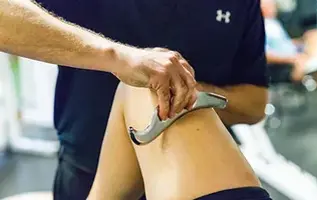
IASTM stands for Instrument-Assisted Soft Tissue Mobilization. The technique uses specially contoured metal instruments to apply controlled, targeted pressure along muscles, tendons, fascia, and ligaments. The instrument amplifies tactile feedback, allowing detection of tissue restrictions that are difficult to locate by hand alone.
The mechanical action is specific. When the instrument moves across restricted tissue, it creates microtrauma at the treatment site. That microtrauma triggers a localized inflammatory response — the same repair cascade your body uses after injury. Fibroblasts migrate to the area, lay down new collagen, and begin remodeling disorganized scar tissue into functional, aligned connective tissue.
Simultaneously, IASTM produces a neurological effect. Repeated stimulation of mechanoreceptors in the treated tissue reduces pain sensitivity and interrupts the chronic guarding patterns that keep a restriction locked in place. The result is not just structural change — it is a reset of how the nervous system perceives and loads that tissue.
The Evidence
The Science Behind Instrument-Assisted Soft Tissue Mobilization
IASTM is not a trend. The physiological rationale — fibroblast proliferation, collagen remodeling, and neurological desensitization — is consistent with established connective tissue biology. Research has documented measurable changes in tissue stiffness, range of motion, and pain thresholds following IASTM application across a range of musculoskeletal conditions.
The technique is applied here within a diagnostic framework. I assess tissue quality, movement patterns, and pain behavior before selecting instrument geometry, pressure, and direction. The instrument is a tool for executing a clinical decision — not a protocol applied uniformly regardless of presentation.
Root cause is the operating principle: effective treatment requires understanding why your body is in pain, not just where. Manual therapy addresses tissue restrictions. Movement analysis finds the compensation patterns. Postural correction addresses the structural drivers that keep re-creating the problem. Separate those, and you get temporary relief. Integrate them, and you get lasting results.
Applications
What IASTM Treats — Conditions and Use Cases
IASTM is most effective where restricted connective tissue is the primary driver of pain or limited movement. That includes acute injuries that have laid down disorganized scar tissue, chronic conditions where fascial restriction has accumulated over years, and post-surgical cases where adhesions are limiting recovery.
Scar Tissue and Post-Surgical Restriction
After surgery or significant injury, the body lays down collagen rapidly and without the organized fiber alignment of healthy tissue. That scar tissue adheres to surrounding structures, limits joint mobility, and creates compensatory loading patterns that cause secondary pain elsewhere. IASTM directly addresses this — breaking adhesions, stimulating collagen remodeling, and restoring tissue glide.
ViewChronic Tendinopathy
Conditions like Achilles tendinopathy, patellar tendinopathy, and lateral epicondylitis involve degenerative changes in tendon tissue that do not resolve with rest alone. IASTM stimulates the repair response in tissue that has become metabolically stagnant.
ViewIT Band Syndrome and Fascial Restriction
The IT band itself does not stretch — but the fascial tissue surrounding it can be mobilized. IASTM applied along the lateral thigh addresses the adhesions and restrictions that drive IT band pain in runners and cyclists.
ViewRotator Cuff and Shoulder Dysfunction
Restricted capsular tissue, scar tissue from prior injury, and fascial tightness around the shoulder girdle all respond to instrument-assisted mobilization when combined with targeted movement retraining.
ViewNeck Pain, Tension Headaches, and Forward Head Posture
Chronic tension in the suboccipital and cervical fascia contributes to both neck pain and tension headaches. IASTM along the posterior cervical chain, combined with postural correction work, addresses the tissue restriction driving the symptom pattern.
ViewChronic Pain After Failed Treatment
Pain that has not responded to prior therapy, reassessed from the mechanism up.
ViewDisambiguation
IASTM vs. Graston Technique: Understanding the Difference
Graston Technique is a branded, proprietary IASTM system — one specific set of instruments and a defined treatment protocol developed and licensed by a single company. IASTM is the broader technique category. Graston is one version of it.
What to Expect During an IASTM Session
The distinction matters clinically. A provider trained exclusively in the Graston protocol applies a standardized approach. I apply instrument-assisted mobilization within a full diagnostic framework — selecting instrument geometry, tissue angle, and pressure based on what I find in assessment, not what a branded protocol specifies. The instruments are tools. The clinical reasoning behind them is what determines the outcome.
Hands-On Evaluation
If you searched for Graston Technique in Baltimore, IASTM as practiced here will address the same tissue targets — and then some. The technique is not brand-dependent.
Plan & First Treatment
The session begins with movement screening and tissue assessment. I identify the restricted areas, determine instrument selection, and explain what I am doing before I begin. You will feel firm pressure — not pain, but significant sensation. Some patients describe it as a deep, focused pressure that is uncomfortable but clearly purposeful.
Treatment time on a given area is typically a few minutes, followed by movement or exercise to load the tissue while it is in a more responsive state. This sequencing — mobilize, then move — is what converts the tissue change into a functional result.
Before You Book
Frequently Asked Questions
Is IASTM the same as the Graston Technique — and which is better?
Graston is a trademarked IASTM system. IASTM is the technique category. Graston uses specific instruments and a licensed protocol; IASTM encompasses multiple instrument systems and approaches. Neither is categorically superior — the clinical outcome depends on the provider's assessment and application, not the brand name on the instruments. At Physica Medica, instrument selection and technique are determined by what the tissue assessment reveals, not by a proprietary protocol.