
Myofascial Cupping — Baltimore, MD
Myofascial Cupping at Physica Medica
Not a spa treatment. Not static cups left on your back for twenty minutes. Myofascial cupping at Physica Medica is a movement-integrated technique applied within a full diagnostic session — designed to decompress restricted fascia, reduce trigger point density, and restore tissue mobility where it has been lost.
The Structural Difference
Myofascial Cupping vs. Traditional Cupping — What Makes This Different
Traditional cupping — the kind practiced in spas and wellness studios — places cups on the skin and holds them in position. The mechanism is superficial suction. It may feel good. It does not address the structural behavior of the fascia beneath.
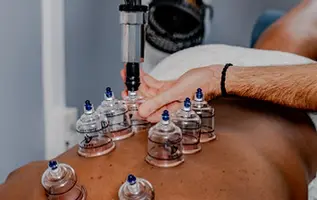
Myofascial cupping works differently. The cup creates negative pressure that lifts the superficial fascia away from the tissue below, creating separation between fascial layers that compression-based techniques cannot reach. While that decompression is active, I move the tissue — either by guiding your limb through a range of motion or by gliding the cup across restricted areas. That combination of suction and movement is what distinguishes it mechanically.
At Physica Medica, cupping is never a standalone appointment. It is one tool within a session that also includes assessment, manual therapy, and movement correction. I apply it where the tissue warrants it, not as a protocol applied uniformly to every patient.
The Mechanism
How Myofascial Cupping Works on Fascia and Soft Tissue
Fascia is the connective tissue that envelops every muscle, nerve, and joint in the body. When it becomes restricted — through injury, repetitive strain, poor posture, or post-surgical scarring — it loses the ability to glide. Adjacent tissue layers adhere. Movement becomes mechanically inefficient, and pain follows.
The negative pressure created by the cup physically separates those adhered layers. Blood flow increases in the decompressed zone. The nervous system registers the mechanical stimulus and begins to down-regulate local tone. When I combine that decompression with active or passive movement, I am retraining the tissue to glide through its full range — not just temporarily releasing tension.
The research on myofascial cupping is still developing, but the available evidence supports its effect on pain pressure thresholds, range of motion, and myofascial trigger point sensitivity. I use it where the clinical presentation warrants it, not because it is a popular technique.
Clinical Applications
What Myofascial Cupping Treats at Physica Medica
Myofascial cupping is most effective where restricted fascia is contributing directly to the symptom pattern. That includes:
Chronic Back and Neck Pain
Fascial restrictions along the thoracolumbar fascia and cervical region are common drivers of recurring back and neck pain that compression-based manual therapy has not resolved.
I had a great experience getting treatment from Dr. Maks. I was having lower back problems and felt like my self-treatment stalled so I started to work with him. He helped me diagnose my injury and was very knowledgeable around different strategies that helped me get to full recovery.Chronic Back and Neck Pain
Fascial restrictions along the thoracolumbar fascia and cervical region are common drivers of recurring back and neck pain that compression-based manual therapy has not resolved.
Maks is not only knowledgeable, but highly intuitive, thus making him a natural healer. He's attentive and compassionate, and if you are willing to put in the work he is willing to support you every step of the way.What to Expect
What to Expect: Marks, Sensation, and Recovery
The Marks
Myofascial cupping produces circular discoloration on the skin. They are not bruises. A bruise results from blunt trauma that ruptures capillaries. Cupping marks result from suction drawing stagnant interstitial fluid and metabolic byproducts toward the surface — a fundamentally different mechanism. The appearance can range from light pink to deep red or purple depending on the degree of fascial restriction in that area. More restricted tissue typically produces darker marks.
The Sensation
They are visible. If you are wearing a backless dress or going to the pool within a few days of your session, plan accordingly. Most marks resolve within three to seven days. They do not require any specific aftercare beyond normal hydration.
After the Session
The suction creates a pulling pressure — not sharp pain. Most patients describe it as intense but tolerable, similar to a deep tissue release. I adjust cup pressure and movement speed based on your feedback throughout the session. If the sensation crosses into pain, that is information, not a requirement.
Plan & First Treatment
Some patients notice immediate improvement in range of motion and a reduction in tightness. Others feel mild soreness for twenty-four to forty-eight hours as the tissue responds. Drink water. Avoid aggressive heat or ice directly over the treated area the same day.
Plan for sixty minutes. Frequency depends on the condition. Most patients start weekly, and we taper as your body holds the changes. You will know within three to five sessions whether the approach is working, and I will tell you honestly if it isn't.
Candidacy
Who Is a Good Candidate for Myofascial Cupping?
Myofascial cupping is appropriate for most adults with musculoskeletal pain involving fascial restriction, trigger points, or post-surgical adhesions. It is not appropriate over open wounds, active skin infections, areas of acute inflammation, or in patients on blood thinners where the visible tissue response would be clinically contraindicated. Pregnancy, certain medical conditions, and specific medications require case-by-case assessment before treatment.