
Postural Re-Education
Posture Correction Is Not Stretching — It's Re-Education
Your posture is the output of a neuromuscular pattern your body has been rehearsing, often for years. Stretching the tight muscles does not rewrite the pattern. Postural re-education does — by identifying which structures are driving the dysfunction and training the nervous system to hold the skeleton differently.
The Definition
What Poor Posture Is Actually Doing to Your Body
Forward head posture adds compressive load to the cervical spine with every inch the head drifts in front of the shoulders. Thoracic kyphosis flattens the ribcage, restricts diaphragm excursion, and shifts load onto the lumbar spine. Sacroiliac joint misalignment alters hip mechanics and feeds directly into recurring hamstring and IT band problems. These are not separate complaints. They are one system compensating across multiple regions.
This is why treating one area in isolation rarely holds. A clinician who addresses your neck pain without examining your thoracic curve and breathing mechanics is managing a symptom, not correcting a pattern. The pain returns because the mechanical cause was never touched.
Postural re-education starts from the structure up: how your skeleton is loaded, which soft tissues are chronically shortened or neurologically inhibited, and what movement habits are maintaining the problem. That is the clinical question. The visible slouch is just where the answer becomes obvious.
Conditions Addressed
The Conditions We Correct
Forward head posture and text neck are among the most common presentations — the head translates forward, the suboccipital muscles compress, and tension headaches follow. Thoracic kyphosis, the rounded upper back associated with desk work and prolonged sitting, restricts shoulder mobility and accelerates cervical degeneration. Scoliosis management addresses the asymmetrical loading patterns that drive pain and progression. Anterior pelvic tilt and SI joint dysfunction alter gait mechanics and contribute to chronic low back pain and sciatica. Postural dysfunction during pregnancy shifts the center of gravity and loads the lumbar spine and pelvic floor in ways that require specific corrective strategies.
Post-surgical posture correction addresses the guarded, asymmetrical movement patterns that develop after procedures — patterns that persist long after the incision heals and that, if left uncorrected, create secondary dysfunction in adjacent regions.
If your condition is not listed, that does not mean it falls outside this practice. The assessment determines fit.
The Method
How Dr. Birikov Approaches Postural Re-Education
The first session is an assessment, not a generic intake. I examine your static posture, your movement patterns under load, and the tissue quality of the structures driving the compensation. I am looking for the primary restriction — the place in the chain where correcting one thing changes several others downstream.
Movement Re-Patterning
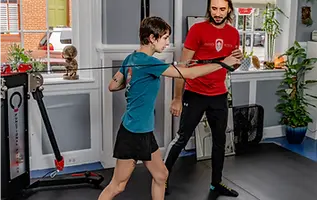
Corrective exercise at this practice is not a printout of generic stretches. It is specific neuromuscular cuing targeted at the inhibited muscles your body has learned to bypass. Most patients with chronic postural dysfunction are not weak in the conventional sense — they are neurologically disorganized. The work is teaching the nervous system to recruit the right structures in the right sequence.
ViewBreathing as a Structural Tool
Diaphragmatic mechanics are inseparable from thoracic and cervical posture. A compressed ribcage forces accessory breathing muscles — the scalenes and upper trapezius — to do work they were not designed for chronically, which drives neck tension and forward head posture. Breathing re-education is a clinical intervention here, not a wellness add-on. My background as the first Wim Hof certified instructor in Baltimore informs this work directly.
ViewOne Provider, Every Session
Postural re-education requires continuity of observation. I need to see how your pattern shifts week to week — what has changed, what has not, and where the next restriction is. That clinical picture cannot be assembled across multiple providers or handed off to a technician. Every session is with me.
ViewSports Injuries
Recurring injuries in the IT band, hamstring, or ankle treated at the movement pattern, not the symptom.
ViewChronic Pain After Failed Treatment
Pain that has not responded to prior therapy, reassessed from the mechanism up.
ViewThe Tools
Pancafit, IASTM, and the Tools Behind the Method
Pancafit
Pancafit is a postural stretching apparatus developed in Italy and based on the Global Postural Re-education method. It works by placing the body in progressive, sustained positions that lengthen the entire myofascial chain rather than isolating individual muscles. This matters because postural dysfunction is a chain problem — the fascia connecting your posterior chain from the base of the skull to the heel does not respond to segmental stretching the way it responds to global tension applied over time. Physica Medica is the only Pancafit provider in the United States. There is no comparable class or session available at any other clinic in the country.
IASTM
Instrument-Assisted Soft Tissue Mobilization uses specifically shaped stainless steel tools to detect and treat restrictions in the fascial layer. The instrument transmits feedback through the clinician's hand that fingertip palpation cannot reliably detect — areas of fibrosis, adhesion, or thickened fascia that are maintaining a postural restriction. The technique stimulates local tissue remodeling and restores glide between fascial planes. It is not a scraping massage. The tool is diagnostic and therapeutic simultaneously.
Dry Needling
Where chronic muscle shortening is neurologically maintained — trigger points that have not released through manual work — dry needling addresses the motor endplate directly. A monofilament needle is inserted into the trigger point to produce a local twitch response, which resets the neuromuscular signaling driving the contraction. This is a mechanical intervention at the tissue level, not an acupuncture protocol. The target is the dysfunctional motor unit, not a meridian.
Plan & First Treatment
I explain what I found, give you a session estimate, and treatment begins the same day.
Plan for sixty minutes. Frequency depends on the condition. Most patients start weekly, and we taper as your body holds the changes. You will know within three to five sessions whether the approach is working, and I will tell you honestly if it isn't.
Common Questions
Before Your First Session
Can forward head posture actually be corrected in adults?
Yes, with qualifications. The degree of correction depends on how long the pattern has been present, whether structural changes have occurred in the cervical discs or vertebrae, and how consistently the corrective work is applied. In adults without significant degenerative changes, meaningful postural correction is achievable — but it requires more than passive treatment. The nervous system has to relearn a default position, which takes repetition and time. Patients who engage with the home exercise component between sessions see faster and more durable results than those who rely on in-clinic treatment alone.