
Exclusive to Physica Medica
The Only Pancafit Class in the United States
Pancafit is a global postural re-education system used across Europe and South America. In the United States, there is one provider: Physica Medica in Baltimore. If you are in Maryland, you have access to something no one else in the country offers.
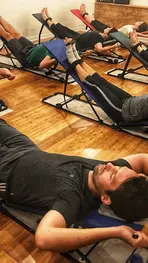
The Method
What Is Pancafit — And Why It Works
Pancafit is not stretching. It is not yoga. It is a proprietary postural re-education system developed in Italy, built around a specialized piece of equipment designed to lengthen fascial chains under controlled load. The distinction matters mechanically. Passive stretching targets individual muscles in isolation. Pancafit works on the full myofascial chains — the continuous lines of connective tissue that run from your feet to your skull — while your body is actively positioned against resistance. That is a fundamentally different stimulus, and it produces fundamentally different results.
Fascia does not respond well to brief, passive pulls. It responds to sustained tension applied along its functional lines. Pancafit holds the body in precisely calibrated positions on the equipment for extended periods, allowing the connective tissue to reorganize rather than simply lengthen temporarily. The postural corrections that result are not cosmetic. They reflect actual changes in tissue length and joint mechanics.
The system was developed by Daniele Raggi and has been taught and practiced across Europe for decades. I trained in the method directly and brought it to the United States. There is currently no other certified Pancafit provider in the country.
Format and Structure
Group Classes vs. One-on-One Sessions
Pancafit at Physica Medica is offered in a small group class format. This is intentional. The method was designed to be taught progressively, with the practitioner guiding participants through positions on the equipment while observing and adjusting in real time. A group setting allows you to work alongside others at similar stages, which supports consistency and accountability without sacrificing the hands-on attention the method requires.
Class size is limited. I am the only instructor, and each session requires direct observation of every participant's positioning on the equipment. If a position is wrong, the therapeutic effect is lost and the risk of strain increases. Small numbers are not a preference — they are a clinical requirement.
For patients with specific diagnoses, significant postural asymmetry, post-surgical history, or conditions like scoliosis, a one-on-one session may be more appropriate before joining a group class. Contact the practice to discuss which format fits your situation.
Clinical Applications
What Pancafit Corrects
Pancafit addresses postural and fascial dysfunction at the chain level, not the symptom level. The following are the most common presentations that respond well to the method.
Forward Head Posture
The forward shift of the skull relative to the shoulders loads the cervical spine and upper trapezius chronically. Pancafit repositions the entire anterior chain — from the hip flexors through the chest and neck — to address the source of that load, not just the site of pain.
ViewHunched Back and Thoracic Kyphosis
Excessive rounding of the upper back compresses the thoracic spine and restricts breathing mechanics. Pancafit works the posterior chain in extension under load to restore thoracic mobility and correct the anterior fascial shortening that drives the rounding.
ViewScoliosis — Non-Surgical Management
Pancafit is used internationally as a conservative intervention for scoliosis. The equipment allows asymmetric positioning to address the rotational and lateral components of the curve without surgical intervention.
ViewChronic Back and Neck Pain
Back pain and neck pain driven by postural collapse and fascial restriction rather than structural pathology respond well to fascial chain re-education. If prior PT addressed the local muscles but not the broader pattern, Pancafit works at the level the prior treatment missed.
ViewRecurring Sports Injuries
Injuries that keep returning — IT band syndrome, hamstring strains, shoulder impingement — are often driven by postural and movement chain imbalances that local treatment never resolves. Pancafit addresses the chain mechanics that load the injury site repeatedly.
ViewPregnancy-Related Postural Pain
The postural shifts of pregnancy — anterior pelvic tilt, lumbar hyperlordosis, upper back strain — respond well to gentle fascial chain work. Pancafit can be adapted for appropriate stages of pregnancy.
ViewPost-Surgical Postural Rehabilitation
After spinal or orthopedic surgery, postural patterns often remain compensated even after the surgical site heals. Pancafit re-educates the full chain once the patient is cleared for progressive loading.
ViewBefore You Arrive
Who Should Take a Pancafit Class
You Have Noticeable Postural Changes
If you or someone else has observed that your posture has shifted — head forward, shoulders rounded, one hip higher than the other, visible spinal curve — that is a fascial chain problem, not a willpower problem. Reminders to stand up straight do not change tissue length. Pancafit does.
Physical Therapy Helped but Did Not Hold
Standard PT addresses local muscle strength and joint mobility. If your symptoms improved temporarily but returned, the underlying postural pattern was likely never addressed. Pancafit works at the chain level that most PT protocols do not reach.
You Have Tension Headaches or Jaw Pain
Tension headaches and TMJ symptoms are frequently driven by anterior chain tightness and forward head posture. The cervical and cranial fascial connections mean that correcting the thoracic and cervical chain often reduces headache frequency without treating the head directly.
You Sit for Long Hours and Feel It
Prolonged sitting shortens the hip flexors, collapses the thoracic spine, and drives the head forward. These are not inevitable consequences of desk work — they are fascial adaptations that Pancafit can reverse with consistent application.
No physical therapy diagnosis is required to take a Pancafit class. If you have a complex or post-surgical history, contact the practice before booking so I can confirm the class format is appropriate for your current status.
Common Questions
Reserve Your Spot — Limited Availability
What is Pancafit and how is it different from stretching or yoga?
Stretching and yoga work primarily on individual muscles in isolation, and most of the length gained is temporary. Yoga improves mobility and body awareness, but it does not apply sustained, calibrated tension along specific fascial chains under load. Pancafit uses proprietary equipment to position the body so that an entire myofascial chain — a continuous line of connective tissue spanning multiple joints — is placed under controlled tension for an extended hold. The tissue reorganizes rather than simply elongating temporarily. The postural changes that result are structural, not just symptomatic.