
Specialty Program — Diaphragmatic Rehabilitation
The Diaphragm Is Not Just a Breathing Muscle
Most physical therapists never assess the diaphragm. I do — because diaphragm dysfunction is a structural problem, not a respiratory one. When this muscle fails to function correctly, the consequences show up as back pain, postural collapse, spinal instability, and recurring injuries that don't resolve with standard treatment.
The Definition
What Diaphragmatic Dysfunction Looks Like
The diaphragm is the primary driver of intra-abdominal pressure — the internal force that stabilizes the spine before any limb movement occurs. When it doesn't activate correctly, the body compensates. Superficial muscles in the neck, lower back, and hips take over stabilization work they were never designed to do. The result is chronic tension, joint loading, and pain that keeps returning regardless of how much stretching or strengthening you do.
Patients with this pattern often describe a familiar frustration: they've done core work, they've seen multiple providers, and nothing holds. That's not a coincidence. Exercises that target surface muscles won't fix a pressure system that's broken at the source.
Breathing pattern disorders also drive forward head posture, rib flare, and thoracic kyphosis. When the diaphragm doesn't descend fully on inhalation, the scalenes and accessory neck muscles compensate — pulling the head forward and loading the cervical spine with every breath, hundreds of times per hour.
Clinical Presentation
Who This Program Is For
Diaphragmatic rehabilitation is appropriate for a specific set of presentations. Patients with chronic low back pain that hasn't resolved with conventional PT. Patients with persistent neck pain and tension headaches tied to poor breathing mechanics. Patients with scoliosis — spinal curves frequently compromise thoracic mobility and breathing symmetry, and correcting one without addressing the other produces incomplete results.
Singers and professional voice users are a distinct group. Diaphragmatic control is the mechanical foundation of breath support, and when that control breaks down, vocal strain follows. This program connects directly to my work with performers — the same assessment that identifies postural dysfunction in a back pain patient identifies the pressure failures that limit a singer's range and endurance.
Patients preparing for or recovering from Wim Hof breathwork training also benefit from a clinical baseline. Breathing mechanics that are structurally compromised before intensive breathwork practice can produce adverse responses. Assessment first is not optional.
Method
How Rehabilitation Works — The Clinical Approach
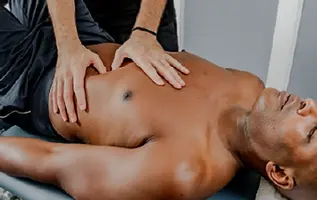
The assessment comes first. I evaluate diaphragmatic excursion, rib cage mechanics, intra-abdominal pressure generation, and how breathing patterns interact with your posture and movement. This is not a standard intake. It requires hands-on palpation and movement screening that most PT clinics don't perform.
Fascial Release and Manual Therapy
Restrictions in the thoracic fascia, costal attachments, and the thoracolumbar junction directly limit diaphragmatic descent. Manual therapy targets these structures before any breathing retraining begins — because you cannot retrain a muscle that is mechanically restricted.
ViewNeuromuscular Re-Education
Once mechanical restrictions are addressed, the work shifts to restoring correct activation timing and pressure coordination. This is not deep breathing instruction. It is precise neuromuscular retraining, progressed systematically and monitored in real time.
ViewPancafit Integration
For patients with significant postural involvement, Pancafit postural stretching addresses the global fascial chains that maintain compensatory patterns. Physica Medica is the only Pancafit provider in the United States. Diaphragmatic rehabilitation and Pancafit work together when the structural picture requires both.
ViewSports Injuries
Recurring injuries in the IT band, hamstring, or ankle treated at the movement pattern, not the symptom.
ViewChronic Pain After Failed Treatment
Pain that has not responded to prior therapy, reassessed from the mechanism up.
ViewMechanism
The Connection to Posture, Pain, and Performance
Comprehensive Assessment
Posture is not a habit. It is a pressure system. The diaphragm, pelvic floor, deep abdominals, and spinal extensors function as a pressurized canister that holds the spine upright under load. When the diaphragm is the weak link in that system, the entire canister fails — and no amount of postural cueing will fix a pressure problem.
Movement Screening
This is why the diaphragmatic rehabilitation program intersects with so many other conditions treated at Physica Medica. Sciatica patients often have compromised intra-abdominal pressure driving lumbar instability. Shoulder pain patients frequently show thoracic restriction that limits both glenohumeral mechanics and rib cage expansion. The diaphragm sits at the center of all of it.
Hands-On Evaluation
For performance — whether that means returning to sport, sustaining a vocal career, or completing a Wim Hof protocol without adverse effects — diaphragmatic function is not optional. It is the structural baseline everything else is built on.
Plan & First Treatment
I explain what I found, give you a session estimate, and treatment begins the same day.
Plan for sixty minutes. Frequency depends on the condition. Most patients start weekly, and we taper as your body holds the changes. You will know within three to five sessions whether the approach is working, and I will tell you honestly if it isn't.
Before You Book
Frequently Asked Questions
Can physical therapy actually improve breathing mechanics?
Yes — with the right assessment. Breathing mechanics are determined by the mobility of the thoracic spine and rib cage, the length and activation of the diaphragm and accessory muscles, and the coordination of the deep stabilizing system. These are all physical structures, and they respond to manual therapy and neuromuscular retraining. What physical therapy cannot do is improve breathing mechanics it never assesses. The clinical evaluation at Physica Medica specifically targets these structures, which is not standard practice at most PT clinics.